Choosing a supplier for Deep Drawn Stainless Steel Vessels requires more than comparing catalogue photos. Manufacturing quality often appears in small details: smooth internal radii, consistent wall thickness, clean edges, and stable dimensions after forming. These features influence pressure performance, hygiene, cleaning efficiency, and service life.
This guide examines ten manufacturers recognized for their forming expertise, stainless steel processing, inspection practices, and industry experience. Their capabilities may include deep drawing, trimming, polishing, leak testing, laser measurement, and customized production. Material traceability also matters. Reliable manufacturers should clearly identify grades such as 304 or 316L and provide relevant inspection records.
The evaluation considers practical factors, including tooling support, minimum order quantities, tolerances, surface finishes, production capacity, and communication. A factory may produce excellent prototypes but struggle with volume. Another may offer attractive pricing but limited documentation. That difference matters.
No ranking is perfect. Supplier strengths change with equipment, staffing, and project complexity. Buyer requirements also vary widely. A food-processing vessel, laboratory container, and industrial reservoir may need different finishes and testing procedures. Careful verification remains necessary.
The selected companies represent useful starting points for procurement teams, engineers, and product designers. Their real suitability should be confirmed through drawings, samples, technical discussions, and quality audits. Look closely. Ask specific questions. A polished website is not proof of consistent production. Reliable evidence comes from measurable results, responsive support, and repeatable manufacturing performance.
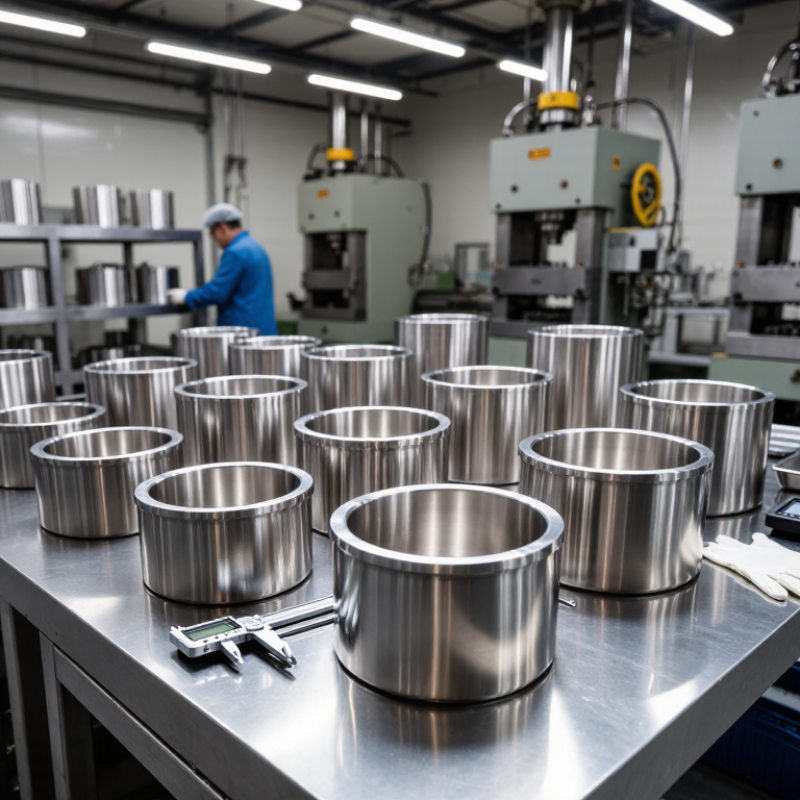
Deep drawn stainless steel vessels are containers formed from a flat metal sheet using controlled pressure and shaped dies. The process stretches the sheet into a seamless body, often reducing weld lines and possible leakage points. Stainless steel provides corrosion resistance, a smooth surface, and good strength under daily handling. These qualities make such vessels useful for food processing, laboratory equipment, chemical storage, and industrial systems.
The final shape may be round, oval, narrow-necked, or customized for a specific installation. Material grade, wall thickness, forming depth, and heat treatment all affect performance. A qualified manufacturer should verify dimensions, surface finish, hardness, and pressure requirements through documented inspections. In practice, a polished surface is not enough. Small thinning areas near the vessel base can remain unnoticed without proper measurement. That detail is easy to miss.
Tips: Ask for material certificates and dimensional reports. Check whether the supplier controls springback after forming. Inspect the rim carefully, because uneven edges can complicate sealing. Also, confirm cleaning requirements before choosing a surface finish. A technically correct vessel may still perform poorly if its geometry does not match the production line. Specifications should be reviewed by an experienced engineer, not copied from an old drawing without reflection.
When comparing deep drawn stainless steel vessel manufacturers, start with evidence, not polished product pages. Ask for material certificates, drawing records, and samples from similar production runs. A capable supplier should explain grade selection, blank diameter, draw ratio, wall thinning, and annealing steps clearly. Experience appears in details: controlled radii, clean flanges, and surfaces without tearing or orange-peel marks. One attractive sample proves little. I learned that the hard way.
Evaluate process control Review incoming material checks, lubrication methods, tooling maintenance, rim finishing, cleaning, and dimensional inspection. Request reports with actual readings, not only “passed” stamps. If the vessel contacts food, chemicals, or pressure systems, confirm applicable standards with a qualified engineer. Traceability matters too. Each batch should connect to heat numbers, inspection data, and shipment records. Ask how nonconforming parts are isolated. Vague answers deserve caution, even when the quotation is low.
Tips: Visit the workshop when practical, or request a live video inspection. Check press capacity, tool storage, gauges, and operator training. Compare lead times against tooling complexity. Send one drawing revision and see whether the team notices it. Do not ignore small inconsistencies. They may become expensive defects. A supplier can be technically strong yet weak in documentation; that gap needs a corrective plan before approval.
The top 10 deep drawn stainless steel vessel manufacturers should be assessed by evidence, not advertising. Buyers should examine tooling control, material traceability, weld inspection, and pressure testing records. A capable factory can produce vessels with smooth walls, stable thickness, and minimal wrinkling. These details matter around the base radius and shoulder area.
Grand View Research reported that the global metal stamping market was worth about USD 265 billion in 2022. Its forecast also indicates steady growth through 2030. This trend supports rising demand for deep drawn components in food equipment, chemical processing, medical devices, and energy systems. The stainless steel market is expanding too, according to Fortune Business Insights. However, market growth does not prove manufacturing quality.
Ask each shortlisted manufacturer for grade certificates, dimensional reports, and sample inspection data. Look for experience with 304, 316L, and other application-specific grades. A useful audit includes blank diameter control, lubrication practice, draw-ratio management, and polishing consistency. ISO 9001 certification helps, but it cannot replace process evidence. Pressure vessels may also require applicable ASME or regional compliance documentation.
No ranking is perfect. Public data rarely reveals rejection rates, tool-life costs, or delayed delivery patterns. That weakness deserves attention. A reliable supplier should explain corrective actions clearly after defects appear. Factory photographs are helpful, but production records are stronger. The best top-10 list therefore combines technical capability, verified capacity, transparent testing, and recent customer references.
Top 10 Deep Drawn Stainless Steel Vessel Manufacturers?
The strongest manufacturers are not ranked by size alone. They are judged by vessel depth, wall-thickness control, tooling skill, and inspection discipline. The top ten typically produce seamless cups, pressure-resistant housings, sanitary tanks, filter bodies, battery cases, and heat-resistant containers. Their customers often operate in food processing, medical equipment, chemical handling, automotive, energy, and laboratory systems. According to Fortune Business Insights, the global stainless steel market was valued at about USD 130.6 billion in 2023. Its projected growth reflects continuing demand for corrosion-resistant components.
Manufacturing capability matters more than attractive catalogs. Look for progressive deep drawing, multi-stage forming, annealing, laser trimming, and automated dimensional inspection. Experienced plants should control springback, thinning, surface scratches, and tool wear across repeated production runs. ASTM-compliant material traceability and ISO 9001 quality systems also support reliable purchasing decisions. Grand View Research reports continued expansion in the global metal stamping market, driven by transportation, electronics, and industrial applications. That growth creates opportunity, but also inconsistency. A supplier may claim tight tolerances without showing capability studies or sample inspection records. Ask for material certificates, cross-sectional measurements, leak-test results, and production references. Small details matter. A vessel that looks perfect may still fail after welding, polishing, or thermal cycling. Any ranking should remain provisional, because actual performance depends on alloy grade, geometry, volume, and service conditions.
Choosing the right deep drawn stainless steel vessel manufacturer requires more than comparing prices. Review its experience with your vessel shape, metal grade, wall thickness, and drawing depth. A manufacturer may produce excellent cylinders but struggle with narrow openings or deep, wrinkle-sensitive forms. Ask for dimensional reports, material certificates, and process records from recent projects.
During factory evaluations, inspect the tooling area and quality controls. Reliable manufacturers measure parts with calibrated equipment, not visual judgment alone. Confirm how they manage thinning, springback, surface scratches, and cleaning requirements. Prototype testing is valuable, especially when the vessel must resist pressure, heat, corrosion, or repeated washing. I have seen attractive samples fail after forming because the base became too thin. A polished surface can mislead.
Tips: Request a sample made from the same stainless steel grade and similar dimensions. Check the rim, bottom radius, and internal finish under strong light. Discuss tolerances before production begins. Ask how rejected parts are recorded and corrected. Also clarify lead times, tooling ownership, inspection frequency, and packaging protection. Small details matter.
Cost should be judged against consistency, documentation, and technical support. The lowest quotation may exclude tooling changes or additional inspections. A dependable partner explains limitations clearly and welcomes design review. Still, do not accept every recommendation without question. Your engineering team should verify the final drawings, test results, and intended operating conditions before approval.
Use these ten criteria to compare manufacturers. Requirements depend on the vessel’s design, service conditions, applicable codes, and destination market; request project-specific evidence rather than relying on general claims.
| No. | Selection criterion | What to compare | Evidence to request |
|---|---|---|---|
| 1 | Relevant deep-drawing experience | Experience forming vessel shapes and sizes comparable to your design, including the required material and wall thickness. Deep drawing can reduce the number of shell seams, but feasibility depends on geometry, tooling, material, and press capacity. | Anonymized project examples, process route, drawing review, and confirmation of available press and tooling capacity. |
| 2 | Material specification and traceability | Ability to supply the specified stainless-steel grade and product form. Grades such as 304/304L and 316/316L have different compositions and are not interchangeable for every service condition. | Material certificates, heat or lot traceability, and confirmation that the proposed material specification matches the design documents. |
| 3 | Applicable pressure-vessel code | Whether the manufacturer can build to the code and jurisdiction required for the project. ASME Section VIII, Division 1 is one pressure-vessel construction code; EU projects may also fall within the scope of the Pressure Equipment Directive, depending on the equipment and its classification. | Current, scope-relevant certificates or approvals, proposed code of construction, and written confirmation of jurisdictional requirements. |
| 4 | Forming process control | How the supplier controls forming stages, lubrication, blank preparation, and risks such as wrinkling, tearing, or uneven thinning for the proposed geometry. | A proposed forming plan, first-article inspection approach, and documented controls for the critical dimensions and wall-thickness requirements. |
| 5 | Welding capability, if required | For designs with welded closures, nozzles, or other attachments, confirm that welding procedures and personnel meet the governing code or project specification. Applicable qualification systems vary by jurisdiction and code. | Relevant welding procedure and personnel qualification records, weld maps, and inspection plans. |
| 6 | Heat treatment and surface finishing | Whether any required heat treatment, descaling, pickling, passivation, or mechanical finishing is appropriate for the grade, forming history, service, and specification. These steps should not be assumed to be identical for every vessel. | Written process specifications, acceptance criteria, and inspection or treatment records where required. |
| 7 | Inspection and non-destructive examination | Inspection methods and extent should follow the design code, drawings, and purchase specification. Visual, dimensional, liquid-penetrant, radiographic, or other examinations are selected as applicable; no single method is required for every vessel. | Inspection and test plan, examination procedures, acceptance criteria, and personnel qualifications where applicable. |
| 8 | Pressure and leak testing | The proposed pressure or leak test must follow the applicable design code and approved project procedure. Test medium, pressure, and acceptance criteria are design-specific and should not be inferred from a generic benchmark. | Written test procedure, calibrated instrument records, and a completed test report for the supplied vessel. |
| 9 | Quality system and documentation | A documented quality system can support consistent processes, but an ISO 9001 certificate alone does not establish that a particular vessel complies with its design code or purchase specification. | Certificate scope and validity, inspection records, material documentation, nonconformance controls, and the agreed final manufacturing record package. |
| 10 | Dimensional control and delivery planning | Ability to meet drawing tolerances, nozzle locations, surface requirements, packaging needs, and the agreed schedule. Confirm which inspections are performed before shipment and how changes are approved. | A dimensioned inspection plan, agreed schedule and milestones, packaging proposal, and written change-control process. |
Request material certificates, drawing revisions, dimensional reports, and sample inspection data. Actual readings are more useful than a simple “passed” stamp.
No. One smooth sample proves little. Compare several parts from similar production runs. Check wall thickness, flange edges, and orange-peel marks.
Ask how the manufacturer controls blank diameter, draw ratio, lubrication, and annealing. Look closely. The base radius and shoulder can show thinning or wrinkles.
Ask how each batch connects to heat numbers, inspection results, and shipment records. Records matter. Also ask how nonconforming parts are separated.
Review press capacity, tool storage, gauges, operator training, and rim finishing. A live video inspection can help when travel is impractical.
Request cross-sectional thickness measurements, leak-test results, and relevant material records. For food-contact or pressure applications, confirm requirements with a qualified engineer.
No. A certificate supports confidence, but it cannot replace process evidence. Ask for inspection data from repeated runs and clear corrective actions.
Compare the lead time with the tooling complexity and production volume. A low quote may hide delays or weak documentation. That deserves a closer look.
This guide explains what Deep Drawn Stainless Steel Vessels are and why they are widely used in industries that require strength, durability, corrosion resistance, and consistent performance. It introduces the deep drawing process, including how stainless steel sheets are formed into seamless or low-weld vessels with precise dimensions and reliable surface quality. Readers will also learn how to evaluate manufacturers based on material standards, tooling expertise, production capacity, quality control, customization options, lead times, and technical support.
The article presents a neutral overview of ten leading manufacturer categories and compares their key products, industries served, and manufacturing capabilities without focusing on specific brand names. It also discusses applications in sectors such as food processing, chemical production, healthcare, energy, and general industrial equipment. Finally, the guide offers practical advice for selecting the right vessel manufacturer by matching technical requirements, certification needs, budget, order volume, and long-term service expectations.