0%

Choosing reliable SS 430 Induction Base Plates Suppliers Worldwide requires more than comparing prices or polished catalog images. SS 430 is a ferritic stainless steel with magnetic properties, making it suitable for induction cookware applications. However, performance depends on more than magnetism. Plate thickness, flatness, bonding quality, surface finish, and heat distribution all affect the finished pan.

Industry materials consultant Dr. Elena Marquez explains, “A magnetic grade is only the beginning; the finished plate must transfer heat evenly, survive repeated cycling, and remain traceable.” Her observation reflects a common purchasing mistake. A plate may attract a magnet strongly yet develop distortion after repeated heating. That weakness can appear as a loose bond, uneven heating, or a visible base ring.

The strongest suppliers provide measurable specifications. Look for controlled SS 430 chemistry, consistent thickness tolerances, clean stamping, and secure aluminum or stainless bonding. Ask how suppliers test thermal cycling, adhesion, corrosion resistance, and dimensional stability. Factory audits also matter. So does batch traceability.

Details reveal experience.

A dependable manufacturer should share inspection records, sample results, and production photographs without hesitation. Export capability is useful, but it does not replace engineering discipline. Some suppliers advertise broad certifications while offering limited technical evidence. That deserves careful review.

This guide examines leading SS 430 Induction Base Plates Suppliers Worldwide through product quality, manufacturing capability, testing practices, delivery reliability, and customer support. The comparison is not perfect, because supplier data can change. Buyers should verify current specifications before placing orders.
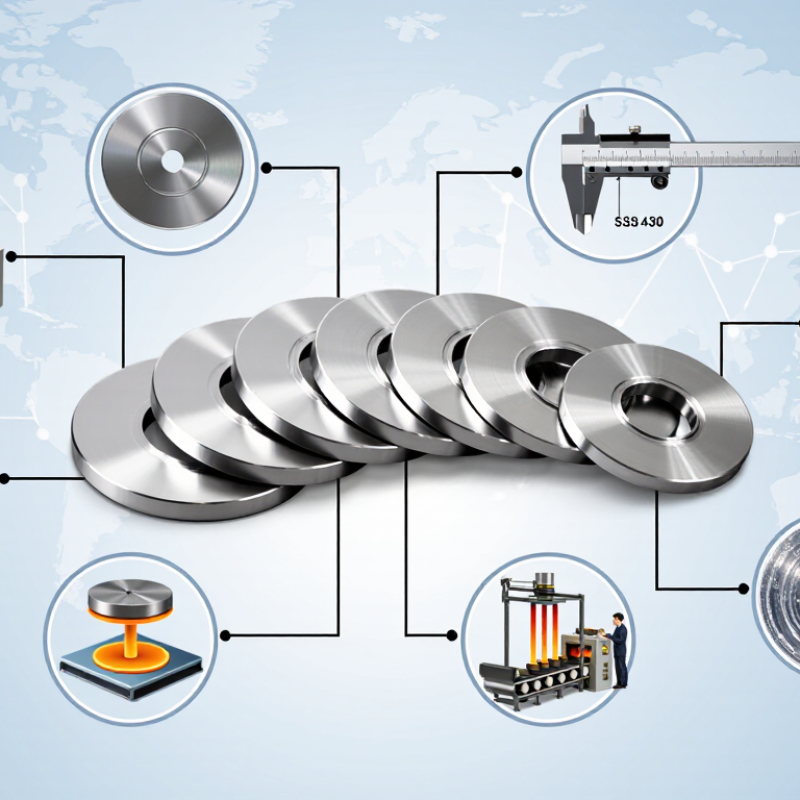
Top SS 430 Induction Base Plates Suppliers Worldwide

Definition and Role of SS 430 Induction Base Plates

SS 430 induction base plates are stainless steel components designed to support induction heating in cookware. SS 430 is a ferritic stainless steel with magnetic properties. That magnetic response allows an induction cooktop to transfer energy through the plate. The plate usually sits beneath an aluminum or stainless steel body. It creates the essential connection between the cookware and the heating field.

Its role is practical, not decorative. A well-made base plate spreads heat across the pan bottom and reduces concentrated hot spots. It can also improve stability on a glass cooktop. In production, thickness, flatness, bonding quality, and edge finishing require close control. A warped plate may cause uneven contact. That can reduce heating efficiency.

From my experience reviewing metal components, performance depends on more than the steel grade. Suppliers should provide composition records, dimensional reports, surface inspection results, and batch traceability. Consistent magnetic response matters. Food-contact suitability and corrosion resistance should also match the intended application and local requirements. Some plates look polished but bond poorly. That weakness appears later, often after repeated heating and cooling. I would not treat a low price as proof of value. A careful buyer should request samples, test thermal distribution, and inspect the bonded interface. Even reliable specifications need practical verification.

Key Material, Design, and Performance Characteristics

Top SS 430 Induction Base Plates Suppliers Worldwide

SS 430 induction base plates combine ferritic stainless steel with magnetic response. This structure supports efficient heating on compatible induction cookers. It also offers useful resistance to moisture, mild acids, and everyday kitchen staining.

Material thickness affects both heating speed and durability. A thicker plate can distribute heat more evenly, but it may respond more slowly. Suppliers should control flatness, edge finishing, and bonding quality during production. Weak bonding can create air gaps between the plate and cookware. Those gaps reduce thermal transfer and may cause uneven cooking. Reliable manufacturers usually provide material certificates, dimensional records, and heat-cycle test results. However, documentation alone cannot replace hands-on inspection. A plate can meet specifications and still feel poorly finished.

Tips: Check magnetic attraction with a simple magnet. Inspect the plate for warping, sharp edges, and visible separation. Ask about repeated heating tests, not only single-cycle performance. Confirm compatibility with your cookware size and induction power range. Supplier response time also matters during quality claims.

Surface texture deserves attention. A smooth finish cleans easily, while excessive polishing may hide small defects. In my view, realistic performance testing is often overlooked. Test samples under repeated heating, cooling, washing, and handling. Results may differ from laboratory conditions, especially with thin cookware or unstable induction zones. A dependable global supplier should explain these limitations clearly.

Top SS 430 Induction Base Plates Suppliers Worldwide - Key Material, Design, and Performance Characteristics

Data Dimension Typical SS 430 Specification or Range Design and Performance Significance Recommended Acceptance Check
Base material AISI 430 / UNS S43000 ferritic stainless steel; commonly aligned with EN 1.4016 Provides a magnetic stainless-steel surface suitable for induction coupling, with good oxidation resistance in normal cookware service. Verify grade by mill certificate, positive material identification, and heat-number traceability.
Chromium content Typically 16.0–18.0% Cr for AISI 430 material Supports corrosion and oxidation resistance while maintaining the ferritic structure required for magnetic response. Check the chemical analysis against the applicable material standard.
Carbon content Usually no more than 0.12% for AISI 430; lower-carbon variants may be specified Lower carbon helps limit sensitization and supports weldability, although 430 is generally selected for formed or clad components rather than extensive welding. Review the heat analysis and confirm the exact governing standard before approval.
Magnetic behavior Ferritic and ferromagnetic at room temperature Enables electromagnetic induction heating; coupling strength depends on plate thickness, geometry, cookware-to-coil spacing, and the induction frequency. Perform a magnet response test and a controlled heating test using the intended induction system.
Common base construction 430 stainless steel / aluminum core / 430 stainless steel, or 430 stainless steel bonded to an aluminum heat-spreading layer 430 supplies magnetic coupling, while aluminum improves lateral heat spreading and reduces hot spots. Confirm layer sequence, thickness, bonding continuity, and absence of delamination by sectioning or approved non-destructive testing.
Typical overall thickness Approximately 1.5–5.0 mm for cookware induction plates; final value depends on vessel size and construction Thicker plates provide greater stiffness and thermal mass but can increase weight, heating time, and material cost. Measure at multiple locations with a calibrated micrometer; define the permitted tolerance on the drawing.
430 magnetic layer thickness Commonly about 0.4–1.5 mm in laminated constructions Must be sufficient to couple effectively with the induction field without creating unnecessary thermal resistance or weight. Verify layer thickness by metallographic cross-section or an approved dimensional method.
Aluminum heat-spreading layer Often approximately 1.0–4.0 mm, depending on the required heat distribution Aluminum has substantially higher thermal conductivity than 430 stainless steel and helps distribute heat across the cooking surface. Check thickness uniformity, bond integrity, and thermal spreading using an infrared or thermocouple mapping test.
Thermal conductivity of 430 Approximately 26 W/m·K near 100°C; published values vary with temperature and product condition Lower conductivity than aluminum explains why a heat-spreading core is often used in multi-layer designs. Use the property value from the specified material standard or approved technical data sheet for thermal calculations.
Electrical resistivity Approximately 0.60 µΩ·m at 20°C; actual value varies by composition and temperature Influences induction losses, heating response, and the temperature-dependent electrical behavior of the magnetic layer. Use a calibrated electrical-resistance method when electrical performance is a critical design parameter.
Melting range Approximately 1,425–1,510°C Provides a high-temperature safety margin for normal cooking use, although local overheating can still cause distortion or surface discoloration. Evaluate maximum service temperature and thermal-cycle requirements separately from the melting range.
Available plate geometry Round, oval, rectangular, or custom profile; cookware diameters commonly range from about 160–320 mm The plate should cover the effective induction zone while avoiding excessive overhang, sharp corners, or unsupported areas. Inspect diameter, roundness, profile, and edge condition against the approved drawing.
Flatness Common production targets are approximately 0.3–1.0 mm total deviation, depending on diameter and forming method Good flatness improves contact with the induction cooktop and reduces uneven heating, rocking, and noise. Measure on a certified flat surface using a feeler gauge, height gauge, or coordinate measurement method.
Surface finish Mill finish, brushed finish, or polished finish; roughness is project-specific A uniform finish supports cleanability, appearance, and consistent contact with the cooking surface. Define roughness, scratches, dents, discoloration, and allowable surface defects on the inspection standard.
Bonding method Cold or hot roll bonding, brazing, or other qualified metallurgical bonding process A continuous bond is essential for efficient heat transfer and for preventing blistering or separation during repeated thermal cycling. Use ultrasonic inspection, peel testing, cross-section analysis, or thermal-cycle testing as appropriate.
Thermal cycling capability Should withstand repeated heating and cooling cycles without visible blistering, cracking, warping, or delamination Mismatch in thermal expansion between stainless steel and aluminum makes process quality and bond design critical. Set the cycle count, temperature range, heating rate, cooling method, and post-test inspection criteria before qualification.
Corrosion resistance Good resistance in household cooking environments; lower than austenitic stainless grades in more aggressive chloride conditions Suitable cleaning practices and controlled exposure to salt, acids, and chlorides help preserve the surface. Specify salt, detergent, humidity, or food-acid exposure tests according to the intended market and use conditions.
Edge and corner design Rolled, chamfered, or radiused edges; sharp exposed edges should be avoided Radiused edges reduce handling injuries, stress concentration, coating damage, and local delamination risk. Inspect burrs, edge radius, cracks, exposed core material, and dimensional conformity.
Induction heating performance Should heat uniformly across the intended cooking zone with stable response at the specified power level Performance depends on the complete cookware system, not SS 430 alone; plate geometry, magnetic mass, core design, and cooktop control all contribute. Record heating time, temperature distribution, power draw, noise, and cookware-to-cooktop compatibility under controlled conditions.

Note: Values shown are typical engineering ranges for qualification and comparison, not a supplier quotation. The applicable material standard, drawing, tolerance specification, and end-use performance test should govern final acceptance.

Global Supplier Types and Regional Market Distribution

The global market for SS 430 induction base plates includes stainless steel mills, precision processors, cookware component manufacturers, and industrial distributors. Each supplier type serves a different purchasing need. Mills usually offer large volumes and controlled chemical composition. Processors provide laser cutting, stamping, polishing, and flatness adjustments. Component manufacturers often deliver plates ready for assembly.

China and India remain important production centers, supported by extensive metalworking capacity and competitive export logistics. Southeast Asian suppliers are gaining attention for cookware assembly and regional distribution. European producers generally compete through tighter dimensional control, traceability, and specialized finishing. North American suppliers often focus on shorter lead times, technical support, and smaller customized orders.

Regional differences matter. A buyer in Germany may request mill certificates, surface roughness records, and strict tolerance reports. A distributor in Southeast Asia may prioritize mixed container loading and flexible packaging. In North America, samples and repeatability testing can influence approval more than the lowest quotation. Practical checks should include magnetic response, thickness consistency, plate warpage, edge quality, and bonding compatibility with aluminum cookware bodies.

Details matter greatly.

Supplier directories can be outdated, and production capability may change after equipment upgrades or subcontracting. This creates an uncomfortable sourcing gap. A supplier may show strong factory photographs but provide weak batch-level documentation. Independent sample testing, video inspections, and clearly written acceptance criteria reduce that risk. However, testing every production variable is rarely economical, so purchasing teams must decide which measurements truly affect induction performance and service life.

Criteria for Evaluating SS 430 Plate Manufacturers

Top SS 430 Induction Base Plates Suppliers Worldwide

When evaluating SS 430 plate manufacturers, examine material control before comparing prices. Reliable suppliers should provide heat numbers, chemical composition, and traceable inspection records. SS 430 offers magnetic response and useful oxidation resistance, but its performance depends on accurate processing. Ask for plate thickness, flatness, surface finish, and dimensional tolerance data. A sample should show clean edges, even polishing, and no visible warping.

Manufacturing capability matters greatly. Review how the induction base is bonded, pressed, or formed, then request thermal cycling results. Repeated heating can expose weak joints, distortion, or surface discoloration. Check whether the factory tests magnetic performance under realistic cookware conditions. Independent laboratory reports add confidence, although documents can become outdated. Confirm their issue dates and batch numbers. Production capacity, packaging methods, and export experience also affect delivery reliability. A strong supplier answers technical questions clearly, not only sales questions.

Tips: Request three recent samples from different batches. Measure flatness with a straightedge and feeler gauge. Test heating uniformity on an induction cooker. Inspect the underside after several heating and cooling cycles. Keep written records of every result. No supplier is perfect. Even a capable factory may miss a small tolerance issue, so repeat inspection remains worthwhile. A polished brochure is not proof. Direct factory communication and a documented corrective process often reveal more.

SS 430 Induction Base Plate Supplier Evaluation: Chemistry Baseline

Use this standardized chemistry baseline when reviewing supplier mill certificates and incoming inspection results. The values represent ASTM A240/A240M Type 430 composition limits; chromium is shown as the midpoint of its 16–18% specified range, while iron remains the balance.

A qualified manufacturer should provide traceable test certificates confirming chemical conformity, heat-to-heat consistency, surface quality, thickness tolerance, and mechanical properties before approval.

Purchasing, Quality Control, and Supplier Verification Steps

Top SS 430 Induction Base Plates Suppliers Worldwide

Purchasing SS 430 induction base plates requires more than comparing unit prices. Confirm the steel grade, plate thickness, diameter tolerance, flatness, and magnetic response. Ask for a material test report for each production batch. A sample should match the approved drawing, not just look polished. In factory evaluations, buyers should inspect stamping tools, storage areas, and surface protection. These details often reveal process discipline.

Tips: Request three samples from different batches. Measure them with a micrometer and flatness gauge. Test adhesion after bonding and heating. Review the supplier’s inspection plan, calibration records, and corrective-action history. Supplier verification should include business registration, production capacity, export experience, and traceable raw-material records. A video tour helps, but an independent audit gives stronger evidence. Do not rely on certificates alone.

Quality control should define acceptable scratches, discoloration, burrs, and warping before purchase. Use a written inspection standard with photographs and measurable limits. Confirm packaging protects edges during long-distance transport. Payment terms should connect to inspection milestones when possible. A low quote may hide higher rejection costs. That lesson is easy to overlook. Recheck assumptions after the first shipment, because even a verified supplier can change materials, tooling, or subcontractors without obvious notice.

FAQS

What is an SS 430 induction base plate?

It is a magnetic stainless steel plate fitted beneath cookware. It connects the pan with the induction heating field. The plate is functional, not decorative.

Why does SS 430 work with induction cooktops?

SS 430 has ferritic magnetic properties. A simple magnet should attach firmly to a suitable plate. Weak attraction may indicate inconsistent material or poor testing.

How does the plate improve cookware performance?

It spreads heat across the pan bottom and reduces concentrated hot spots. It can also improve stability on a glass surface. Results still depend on thickness and bonding.

Which physical features should buyers inspect?

Check thickness, flatness, edge finishing, surface texture, and visible separation. Place the plate on a flat table. Any rocking may signal warping.

How does thickness affect heating?

A thicker plate may distribute heat more evenly. It can also respond more slowly. Thin plates may heat quickly but show stronger temperature differences.

Why is bonding quality important?

Poor bonding can create air gaps between the plate and cookware body. These gaps reduce thermal transfer and encourage uneven cooking. Polished surfaces can still bond badly.

What supplier documents should be requested?

Request composition records, dimensional reports, surface inspection results, and batch traceability. Heat-cycle results are useful too. Paperwork helps, but it is not proof.

How should samples be tested before purchase?

Heat samples repeatedly, then allow them to cool naturally. Inspect them after washing and handling. Measure thermal distribution across the pan bottom.

Do regional suppliers offer different advantages?

Large production centers may provide competitive volume and export capacity. European suppliers often emphasize traceability and tight tolerances. North American suppliers may support smaller customized orders.

Can supplier directories be trusted completely?

Not always. Factory equipment, subcontracting, and production capability can change. Independent inspections reduce uncertainty. I would not approve a supplier from photographs alone.

Conclusion

SS 430 Induction Base Plates are stainless steel components designed to support induction heating systems while providing reliable heat transfer, structural stability, and resistance to oxidation and corrosion. Their performance depends on the material’s chromium content, plate thickness, surface condition, dimensional accuracy, magnetic response, and ability to withstand repeated heating and cooling cycles. Suitable designs should balance thermal efficiency, mechanical strength, fabrication requirements, and service life for applications such as cookware, industrial heating equipment, and thermal processing systems.

The global supplier market includes stainless steel mills, specialized metal fabricators, induction-component manufacturers, and custom engineering companies, with production distributed across major manufacturing regions. When evaluating manufacturers, buyers should review material certifications, production capacity, testing procedures, quality-management systems, technical support, and delivery reliability. Purchasing should include clear specifications, sample approval, batch traceability, dimensional inspection, surface checks, and performance testing. Verifying supplier credentials, certificates, inspection records, and communication practices helps reduce quality risks and supports consistent long-term procurement.


Ethan

Ethan

Ethan is a highly experienced marketing professional dedicated to helping businesses make informed decisions through clear, practical, and industry-focused content. With a strong understanding of the company’s products, services, and customer needs, he regularly contributes expert articles to the......